
Quick Answer: No. Broken glass cannot go in a kerbside recycling bin anywhere in the UK. Wrap it securely and place it in your general waste bin, or take it to a Household Waste Recycling Centre.
Broken glass is one of the household items that catches many people out. Although glass is widely recycled across the UK, not every type can be handled in the same way once it breaks. Disposing of it correctly helps protect waste collection crews, reduces contamination at recycling facilities, and keeps household waste collections running safely and efficiently.
Key Takeaways
- Broken glass cannot go in kerbside recycling bins anywhere in the UK.
- Only unbroken glass bottles and jars are accepted at the kerbside.
- Drinking glasses, Pyrex, mirrors and window glass are never recyclable in household bins, broken or not.
- Wrap broken glass securely and place it in general waste, or take it to a Household Waste Recycling Centre.
Can Broken Glass Be Recycled in the UK?
Yes, broken glass can be recycled in the UK, but it should not go in your household kerbside recycling bin. Although glass is highly recyclable, broken glass needs to be handled differently because it creates safety risks and can contaminate other recyclable materials.
The main reason is safety.
Sharp shards can easily cut waste collection crews while bins are being emptied. They also put workers at recycling facilities at risk when recyclable materials are sorted by hand. Even where sorting is automated, broken glass can damage machinery and interrupt the recycling process.
Broken fragments create another problem.
They can mix with paper, cardboard, plastic and metal collected in the same recycling load. This contamination makes it harder to recover clean materials and can reduce the quality of recyclables that would otherwise be reused.
Although glass is one of the UK’s most recyclable materials, it can only be recycled efficiently when it reaches the right facility in the right condition. Disposing of broken glass correctly helps protect workers, prevents contamination and supports a safer, more effective recycling system.
Why Recycling Rules Vary Between Local Councils
The ban on broken glass in kerbside recycling is the same across the UK. What changes between councils is how recyclable glass is collected.
Some councils use source separated collections, where glass is placed in its own box or container. Others use commingled collections, where glass is collected with paper, plastic and metal before being sorted at a recycling facility. These different collection systems form part of each council’s wider approach to managing household waste and recycling.
This is also reflected in SEPA’s household waste data by nation, which brings together official household waste and recycling data reported by local authorities.
These collection methods are chosen for practical and cost reasons, not because councils have different rules on broken glass.
Councils also differ in the services they provide. Some offer kerbside glass collections, while others ask residents to use local bottle banks instead. That is why recycling guidance can vary from one area to another.
Which Types of Glass Can Be Recycled
It is easy to assume that if it is made of glass, it can be recycled. In reality, that only applies to certain types. Household glass items are treated differently because they are made and processed in different ways.
Before we look at each type of glass in more detail, the table below gives a quick overview of where common household glass items should be disposed of:
| Glass Type | Household Recycling Bin | Bottle Bank | Household Waste Recycling Centre (HWRC) | General Waste |
|---|---|---|---|---|
| Unbroken bottles/jars | Yes | Yes | Yes | Not needed |
| Broken bottles/jars | No | No | Yes | Yes |
| Drinking glasses, Pyrex, mirrors, window glass | No | No | Sometimes (check locally) | Yes |
Glass Bottles
Unbroken glass bottles can be recycled through household kerbside collections where glass is accepted. They can also be taken to a bottle bank or a Household Waste Recycling Centre.
Green, brown and clear bottles are all accepted, provided they are empty and unbroken.
Glass Jars
Food jars, coffee jars, sauce jars, cosmetic jars and other glass containers can be recycled in the same way as glass bottles. They should be empty, unbroken and lightly rinsed before being placed in your recycling or a bottle bank.
Broken Bottles
A glass bottle can no longer be recycled through your household recycling once it has broken. Loose shards create a safety risk for collection crews and recycling workers and can contaminate other recyclable materials.
Wrap broken pieces securely before placing them in general waste, or take larger amounts to a Household Waste Recycling Centre.
Which Types of Glass Should Not Go in Your Recycling Bin?
Glass bottles and jars are only one part of household glass recycling. Several other glass items should always be kept out of your recycling bin because they are made differently and cannot be processed with container glass.
Below, we cover the household glass items that should never go in your recycling and explain why:
Drinking Glasses
Drinking glasses should never go in your household recycling bin.
They are made from a different type of glass that melts at a different temperature from bottles and jars. WRAP’s Spring 2025 Recycling Tracker found that drinking glasses are the biggest source of glass contamination in UK household recycling.
Around one in three households recycle them by mistake. If every UK household made that mistake just once, it would fill more than 363 refuse lorries.
Window Glass
Window glass is made to different specifications from container glass. Its chemical composition and melting point make it unsuitable for the same recycling process.
Mirrors
Mirrors cannot be recycled with bottles and jars because they have a metallic reflective coating on the back. This coating cannot be removed during standard glass recycling.
Pyrex and Heat Resistant Glass
Pyrex and other heat resistant ovenware are made from borosilicate glass. It behaves differently at high temperatures and cannot be recycled with standard container glass.
Toughened and Tempered Glass
Toughened and tempered glass goes through a manufacturing process that changes its structure. That makes it unsuitable for the same recycling stream as bottles and jars.
Light Bulbs and Fluorescent Tubes
Light bulbs and fluorescent tubes require specialist recycling. Some contain hazardous materials, while others are made from glass that is processed differently from standard containers.
If you are unsure which bin other items belong in, we can help you dispose of items that cannot go in your household bins through our professional waste removal service.
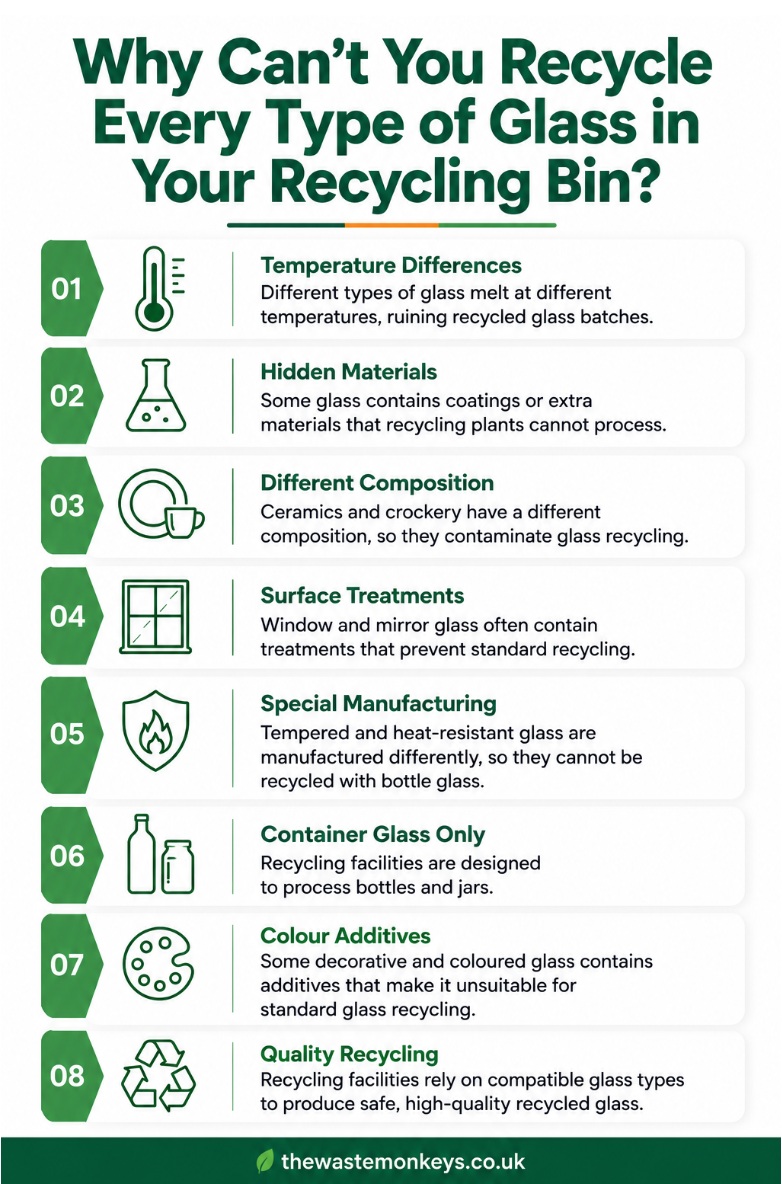
Why Can’t All Glass Be Recycled Together
Glass may look the same, but different products are made for different jobs. That means they cannot all be recycled through the same process.
How to Dispose of Broken Glass Safely
Broken glass can cause serious injuries if it is handled or disposed of carelessly. The safest approach depends on the type of glass and how much there is, but the goal is always the same.
Protect yourself while clearing it up, make it safe for anyone handling the waste, and dispose of it through the correct waste stream.
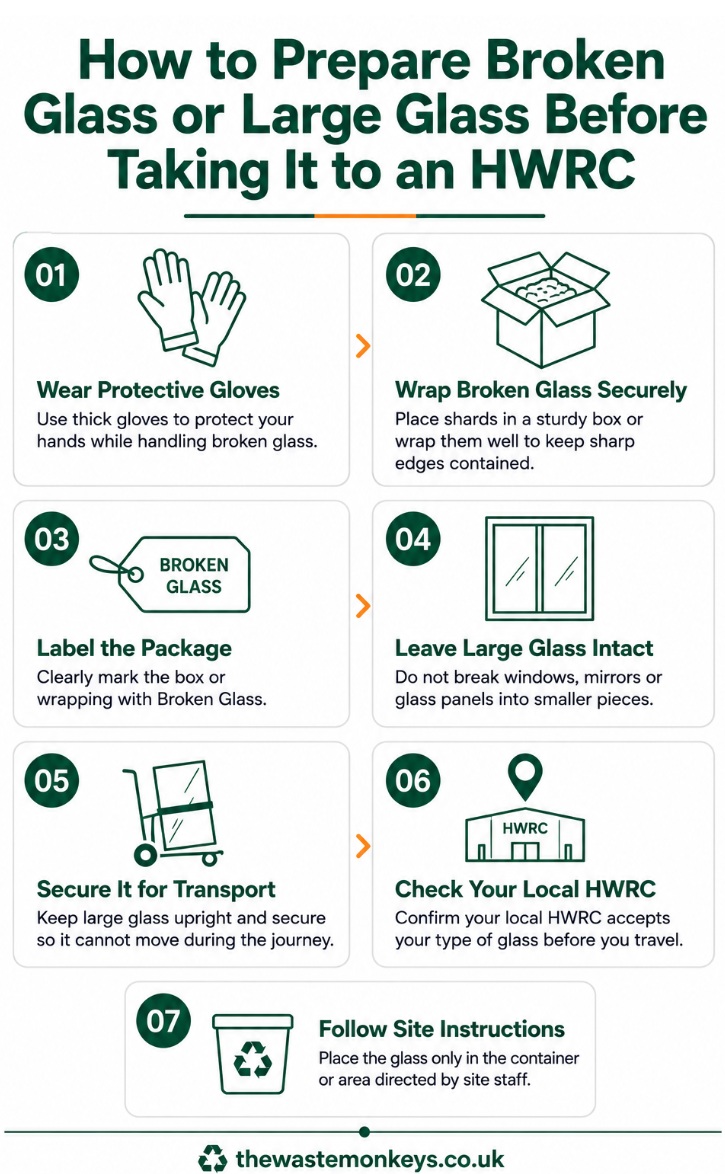
Follow these steps to dispose of broken glass safely:
- Wear sturdy gloves if possible, collect the larger pieces first, then sweep up smaller shards and wipe the area with a damp paper towel to remove tiny fragments.
- Wrap the broken glass in several layers of newspaper, corrugated cardboard or an old towel before placing it in the bin.
- Clearly label the wrapped package as Broken Glass so anyone handling it knows it contains sharp objects.
- Put small amounts of wrapped broken glass in your general waste, but take larger items such as window panes and glass panels to a Household Waste Recycling Centre.
- Use a professional waste removal service if you have large amounts of broken glass from a DIY project or property clear-out.
These simple steps do more than protect your household. They also reduce the risk of injuries for waste collection crews and recycling workers.
According to the HSE, waste and recycling has one of the highest workplace fatal injury rates in Great Britain, making safe handling of sharp waste especially important.
Can You Take Broken Glass to a Household Waste Recycling Centre?
Yes. Household Waste Recycling Centres (HWRCs) are the correct place to dispose of larger pieces of broken glass that should not go in your kerbside recycling or general waste. They provide dedicated disposal areas for materials that standard household collections cannot safely handle.
Always check your local council’s guidance, as accepted glass types vary between centres.
Why Proper Glass Recycling Matters
Getting glass recycling right is not just about following the rules. It has a measurable impact on recycling rates, worker safety and the environment.
Improving Recycling Rates
According to UK statistics on waste from Defra, the UK glass packaging recycling rate in 2024 sits at around 65.7% to 80.4% depending on the calculation methodology used. Correct sorting at home directly affects whether glass reaches the recycling stream or ends up rejected.
Reducing Injury Risk for Collection Crews
The waste and recycling sector records one of the highest injury rates of any UK industry. Proper glass disposal, wrapped, labelled and in the right bin, reduces the risk for workers who handle thousands of collections every week.
Reducing Waste Sent to Landfill
Glass does not biodegrade. A bottle sent to landfill stays there essentially forever. When glass is sorted correctly, it stays in use as a material rather than becoming a permanent fixture underground.
Conserving Raw Materials and Energy
Recycled glass reduces demand for the raw materials needed to manufacture new glass and cuts the energy required in production. The UK glass industry currently achieves a recycling record of 74.2%, and has set an ambitious target of 90% collection by 2030 according to the UK glass industry recycling ambition outlined by British Glass.
Every correctly sorted bottle or jar is a small step towards that target.
FAQs
Can I put broken glass in my recycling bin?
No. Broken glass cannot go in a kerbside recycling bin anywhere in the UK. Wrap it securely and place it in general waste, or take it to an HWRC.
Can drinking glasses be recycled?
No. Drinking glasses are made from a different glass type to bottles and jars. They should go in general waste regardless of whether they are broken or intact.
Can window glass and mirrors be recycled?
Not through household recycling. Window glass and mirrors have different compositions that make them unsuitable for container-glass recycling. Take them to an HWRC instead.
Can Pyrex be recycled?
No. Pyrex is borosilicate glass, which melts at a different temperature to standard container glass. It should go in general waste or to an HWRC.
What happens to glass after it is recycled?
Accepted glass is crushed into a cullet and melted down to make new glass bottles and jars. This closed-loop process uses less energy than making new glass from raw materials.
Conclusion
Broken glass does not belong in kerbside recycling. Wrap it securely before placing it in general waste, or take larger amounts to an HWRC. Correct disposal protects workers and helps keep recycling streams cleaner.
Got broken glass or other household waste to dispose of safely? Get your free quote, and we will take care of it responsibly.