
Quick Answer: Yes, rubbish removal companies collecting someone else’s waste normally need waste carrier authorisation. In England and Wales, this is usually upper tier registration. Scotland and Northern Ireland have separate systems.
Hiring a rubbish removal company means trusting someone else to handle your waste, so checking their authorisation is an important first step. In England and Wales, this is covered by waste carrier registration, while Northern Ireland commonly uses the term waste carrier licence. Although the rules vary slightly across the UK, check the operator details carefully before handing over waste.
Key Takeaways
- Rubbish removal companies generally need waste carrier authorisation to collect other people’s waste legally
- Always check the company’s registration on the official environmental regulator’s public register
- Make sure the registration details match the company actually collecting your rubbish
- Keep evidence of your checks to show you took reasonable steps before handing over waste
Do You Need to Use a Registered Waste Carrier?
Yes, you should use an authorised waste carrier when paying someone to remove your rubbish. This is part of your waste duty of care, which means taking reasonable steps to ensure your waste goes to the right person.
For a homeowner, this applies when arranging a house clearance, garden clearance, or collection of bulky items. Our house clearance services can help when a property needs professional waste removal.
The duty does not simply end once the rubbish leaves your property. You should keep evidence of the checks you made, particularly if you hire a private operator. Businesses have more formal duties, including record-keeping for many waste transfers.
That makes checking the contractor before collection a sensible first step.
What Does a Waste Carrier Registration Cover?
A waste carrier registration allows a business to transport waste as part of its business activities. For companies collecting rubbish from other people, this will generally mean upper tier registration.
This covers businesses that transport household, commercial or construction waste for customers. Lower tier registration applies to specific activities and is not the usual category for rubbish removal companies.
However, registration only covers the transport of waste. It does not automatically allow a company to store, treat or dispose of waste at another site. Those activities may need separate permission.
The GOV.UK waste carrier registration guidance explains who must register, the difference between upper and lower tier registration, and how to check operators on the public register. So, check the carrier’s registration and ask where your waste will be taken.
How Do You Check a Rubbish Removal Company’s Licence (Before Hiring)
You can check a rubbish removal company by obtaining its registration details, searching the relevant regulator’s public register and matching the record to the business you are hiring. A rubbish removal company should meet the legal requirements that apply to waste collection and transport.
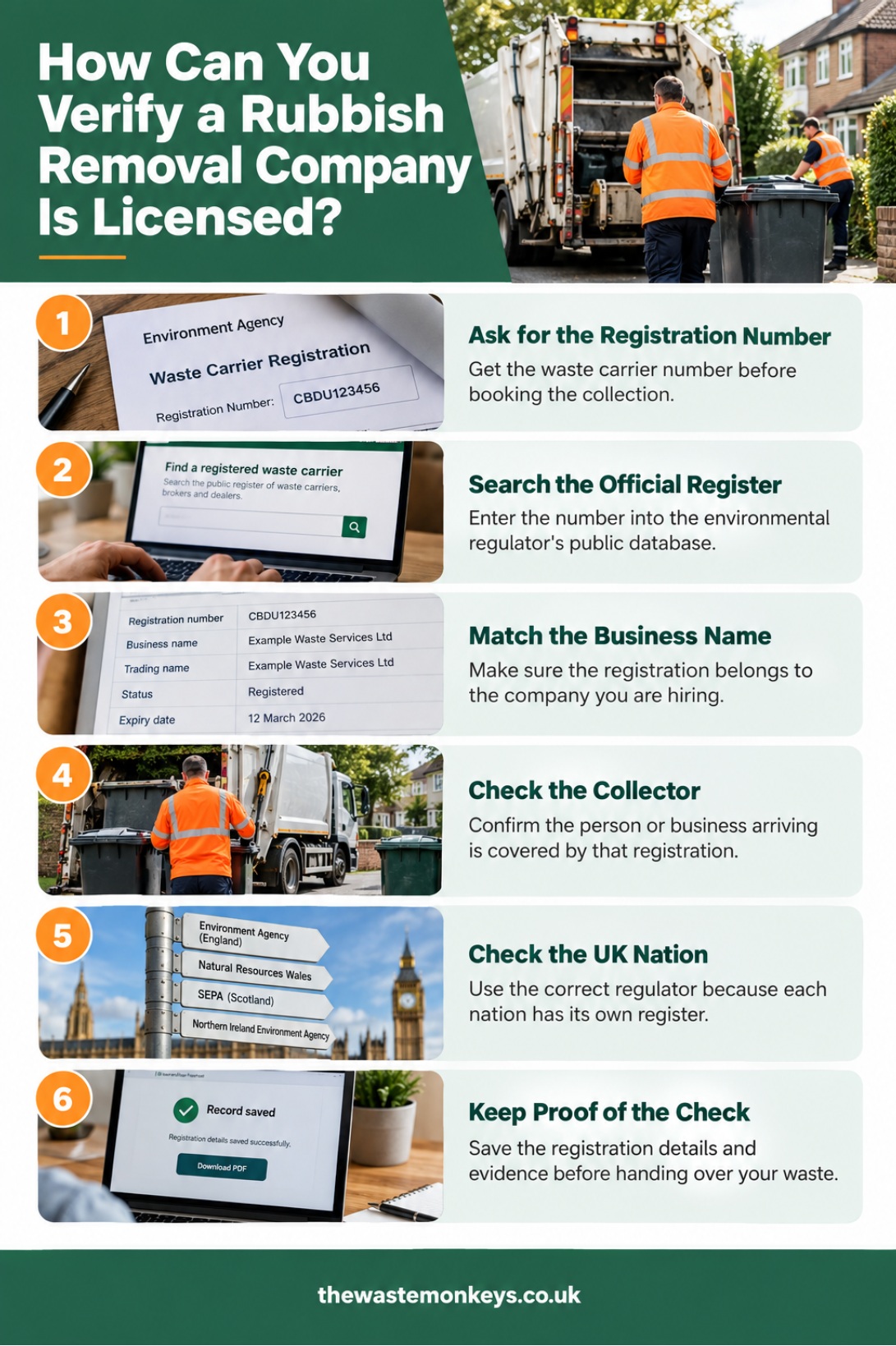
The checks below can help you confirm this before booking the service:
☐ Ask for the Waste Carrier Registration Number
Ask the company for its waste carrier registration number before the collection takes place. A genuine operator should be able to provide these details rather than relying on a verbal claim that it is licensed.
For an England based company, you can then search the Environment Agency waste carrier public register. The register lets you check the operator rather than taking an advert or message at face value.
☐ Check the Company on the Official Register
Search the business through the environmental regulator responsible for the relevant UK nation.
For Scotland, you can check a waste carrier in Scotland through SEPA’s system. Northern Ireland has a separate system, so readers there should check the Northern Ireland waste carrier licence information provided by DAERA and NIEA.
The important part is simple. Use the regulator’s own register rather than a third party directory.
☐ Make Sure the Registration Matches the Business
Finding a valid number is not enough. The registration should belong to the company actually collecting your waste.
Check the business name and other available details against the company you hired. Take extra care where a trader uses several trading names, sends a subcontractor or advertises only as a generic man and van service.
A registration belonging to another operator does not prove that the person turning up at your property is authorised.
☐ Check Where Your Waste Will Go
Ask where the collected rubbish will be taken, especially if the job involves a large volume of waste. The carrier should be able to explain the disposal or recovery route.
For certain waste streams, it can also be appropriate to check whether the receiving facility is authorised to accept that material. The point is not to become a waste management expert. You simply need to know that your rubbish is entering a legitimate route after collection.
What Paperwork Should a Rubbish Removal Company Provide?
For household rubbish, a rubbish removal company does not normally need to give you a waste transfer note for an ordinary collection. Your main responsibility is to make sure the waste is handed to an authorised person and keep evidence of your checks.
Commercial waste has formal paperwork requirements. A non-hazardous waste transfer normally needs a waste transfer note or equivalent record for each load. The record should include:
- Type of waste
- Quantity of waste
- Transfer date
- Details of the sender and receiver
Businesses should keep these records for two years.
Hazardous waste requires different documentation. A hazardous waste consignment note is generally needed when hazardous waste is collected or moved. Before collection, businesses should confirm which document applies and ensure the required information is completed. These records provide evidence that the waste was transferred lawfully.
What Are the Red Flags When Hiring a Rubbish Removal Company?
Certain warning signs should make you pause before booking a rubbish removal company. A missing registration or licence number is an obvious concern. The same applies when the details cannot be found on the relevant regulator’s register. These issues do not automatically prove illegal activity, but they warrant further checks.
Be careful when the registration belongs to a different business or the company uses vague descriptions such as “man and van”. A legitimate operator should be able to explain who will collect your rubbish and how the service operates.
The waste destination also matters. A company that refuses to explain:
- where your rubbish will go
- who will receive it
- whether the destination is authorised
… deserves extra scrutiny.
Businesses should also be cautious if a contractor refuses to provide required commercial paperwork. Cash only arrangements with no clear business information can be another warning sign.
Why Does Checking a Waste Carrier Matter?
Checking a waste carrier matters because your rubbish remains your responsibility after it leaves your property. If waste is passed to an unsuitable operator, it can end up in illegal disposal routes. According to GOV.UK fly tipping statistics for England, there were 1.26 million fly tipping incidents in England during 2024/25, and 62% involved household waste.
This does not mean every unverified rubbish collector will fly tip. However, it shows why choosing an authorised carrier matters. A simple check before collection can reduce the risk of your waste being passed into an illegal disposal route.
Public awareness also remains limited. Research by the National Centre for Social Research found that 57% of surveyed adults knew waste carriers had to be licensed. Only 28% knew that an online database existed. Knowing where to check makes the process easier before you hand over your rubbish.
Could You Be Responsible If Your Rubbish Is Fly-Tipped?
Yes, a householder can have a legal duty even after handing waste to a contractor. Although that does not mean you automatically become liable if the contractor later fly tips it.
As a householder, you should take reasonable steps to make sure your waste is given to an authorised person. This includes:
- checking the rubbish removal company is registered before collection
- matching the registration details to the business you actually hire
- asking where the collected rubbish will be taken after removal
- keeping evidence of the checks made before handing over your waste
You also need to save the carrier’s registration number, collection receipt or other details that show who removed your waste. These records can help demonstrate that you took reasonable steps if the waste is later fly tipped.
Our waste removal services provide a straightforward option for arranging professional waste collection from homes and businesses.
FAQs
Do rubbish removal companies need a licence?
Yes, companies collecting other people’s waste normally need waste carrier authorisation. The exact terminology depends on the UK nation.
How do I check if a rubbish removal company is licensed?
Ask for its registration details, then search the relevant environmental regulator’s public register.
What is an upper tier waste carrier?
It is the category generally used by businesses transporting waste produced by other people, including household and commercial rubbish.
What happens if a rubbish removal company fly tips my waste?
The legal position depends on the circumstances. Checking the carrier and keeping evidence of that check helps demonstrate that reasonable steps were taken.
Can I check a waste carrier licence online?
Yes. England, Wales, Scotland and Northern Ireland each provide regulator based systems for checking waste carrier authorisation.
Conclusion
Commercial rubbish removal companies collecting other people’s waste normally need authorisation, although terminology differs across the UK. The safest approach is simple: get the operator’s registration details, check them through the relevant regulator and keep evidence of your checks before handing over waste.
Need rubbish cleared from your home or business? Get a free quote today and we’ll take care of the collection from start to finish.