Quick Answer: Take old white goods to a Household Waste Recycling Centre, book a council bulky collection, use a retailer take-back scheme, or hire a licensed waste carrier. Never put them in a household bin.
White goods include large household appliances such as fridges, washing machines, freezers and cookers. Because they contain electrical components and, in some cases, hazardous materials, they cannot be thrown away with your general household waste. Disposing of them through the correct route helps protect the environment and ensures you comply with UK waste regulations.
Key Takeaways
- White goods are classed as Waste Electrical and Electronic Equipment (WEEE) and carry legal disposal requirements.
- Recycling is the correct route for both working and broken appliances.
- Disposal options include HWRCs, council collections, retailer take-back schemes and licensed waste carriers.
What Are White Goods
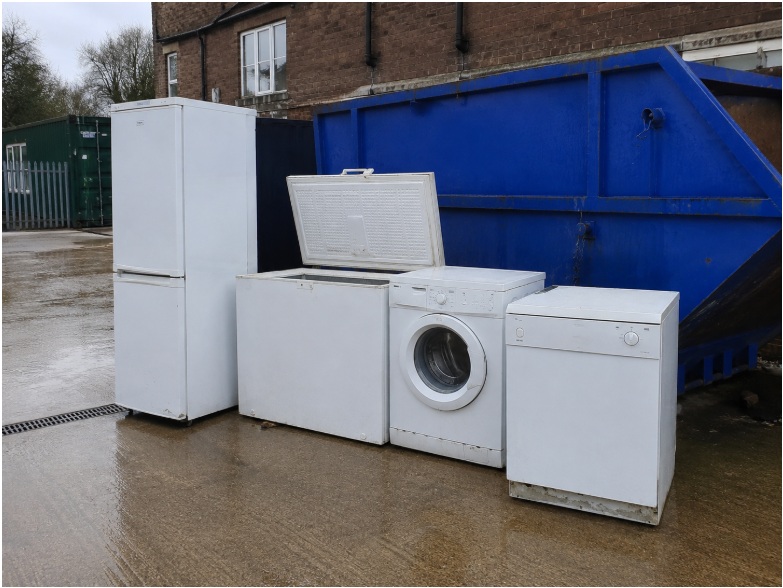
White goods is the everyday name for the large appliances found in most homes. This includes:
- Fridges
- Freezers
- Washing machines
- Tumble dryers
- Dishwashers
- Cookers.
The name comes from the fact that these appliances were traditionally sold in white, even though they are now available in many different colours.
In the UK, white goods are classed as large household electrical appliances under the WEEE Regulations. This means they cannot be put in your general household waste or sent to landfill.
Instead, they must be collected, recycled or disposed of through an approved route to recover valuable materials and reduce environmental harm.
What Do the WEEE Regulations Mean for You
The WEEE Regulations explain how old electrical appliances must be disposed of in the UK. They apply whether you bought your white goods from a local shop or an online retailer.
The aim is simple. Keep electrical waste out of landfill, recover valuable materials and reduce environmental harm.
As a homeowner, your responsibility is straightforward. You must dispose of old white goods through an approved collection or recycling service.
You should never:
- Leave them on the pavement
- Put them in general rubbish
- Use an unlicensed waste collector
- Fly-tip them elsewhere
These actions can result in illegal waste disposal and potential enforcement action.
The safest option is to use a council collection, a retailer take-back service, a Household Waste Recycling Centre or a licensed waste carrier.
Where Should You Take Old White Goods
There is no single correct answer here because the right option depends on your situation. Your appliance might still work, or it might have completely given up.
You might have a car large enough to transport it, or you might not. The good news is that several legitimate routes exist, and at least one of them will suit your circumstances.
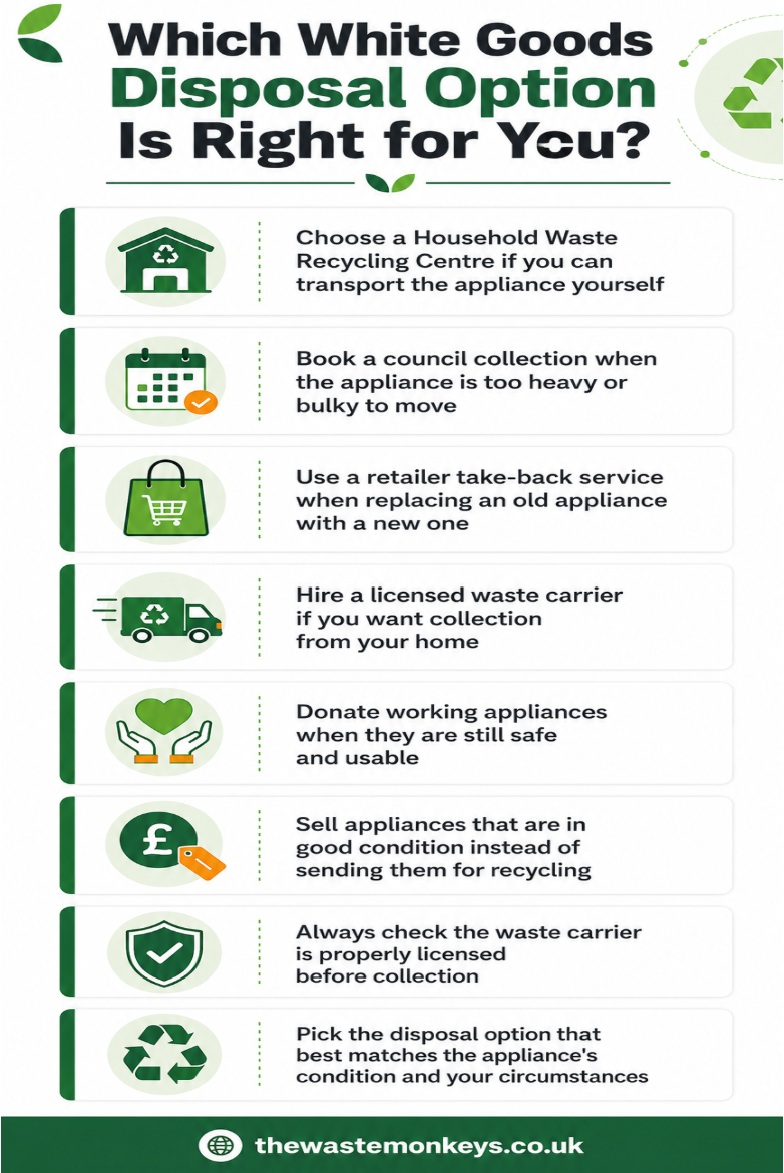
Here are the most suitable options, depending on your circumstances:
Using a Household Waste Recycling Centre (HWRC)
Every local council in the UK is legally required to provide a free WEEE drop-off point, and most HWRCs have a dedicated area for white goods and electricals. You simply transport the appliance yourself, drop it off and that is it. No booking needed in most cases.
Booking a Council Bulky Waste Collection
If shifting a washing machine into a van is not something you fancy, many councils offer a kerbside bulky waste collection service. There is usually a small fee, and you book it online. They come to you, which makes it a decent option for heavy or awkward items.
Retailer Take-Back Schemes
When you buy a new appliance, the retailer can often deliver it and collect the old one at the same time. That means there is no need to arrange a separate disposal trip, making it much easier to replace large appliances while ensuring the old one is disposed of correctly.
This is known as a like-for-like take-back. Larger electrical retailers with a sales area over 400 square metres must also accept small WEEE items in-store without you needing to make a purchase at all.
Always ask about this at the point of sale. It is free, it is convenient, and most people do not realise they are entitled to it.
Using a Licensed Waste Collection Service
A private waste carrier can collect your old white goods from your home, making it one of the easiest disposal options. Before booking a collection, check they have an Upper Tier waste carrier registration with the Environment Agency and are authorised to transport waste legally.
Their registration number should begin with CBDU, giving you confidence that your appliances will be collected and disposed of correctly.
If you hand your appliance to someone without proper registration and they fly-tip it, you could face a fine too.
Our licensed waste removal service collects white goods of any size, fully insured and compliantly handled from start to finish.
Donating or Selling Working Appliances
If the appliance still works, think before you scrap it. Research from WRAP into the reuse potential of household bulky items found that around 32% of items brought to HWRCs were reusable as-is, rising to 51% with minor repairs.
Donation to a local reuse network, a charity shop or a furniture reuse organisation is always worth considering first.
Disposing of white goods is often part of a bigger clear-out. If you are clearing an entire property, our house clearance service covers appliances alongside everything else.
How to Dispose of Different Appliances (White Goods)
Most white goods follow the same general disposal routes, but a few have specific requirements worth knowing about.
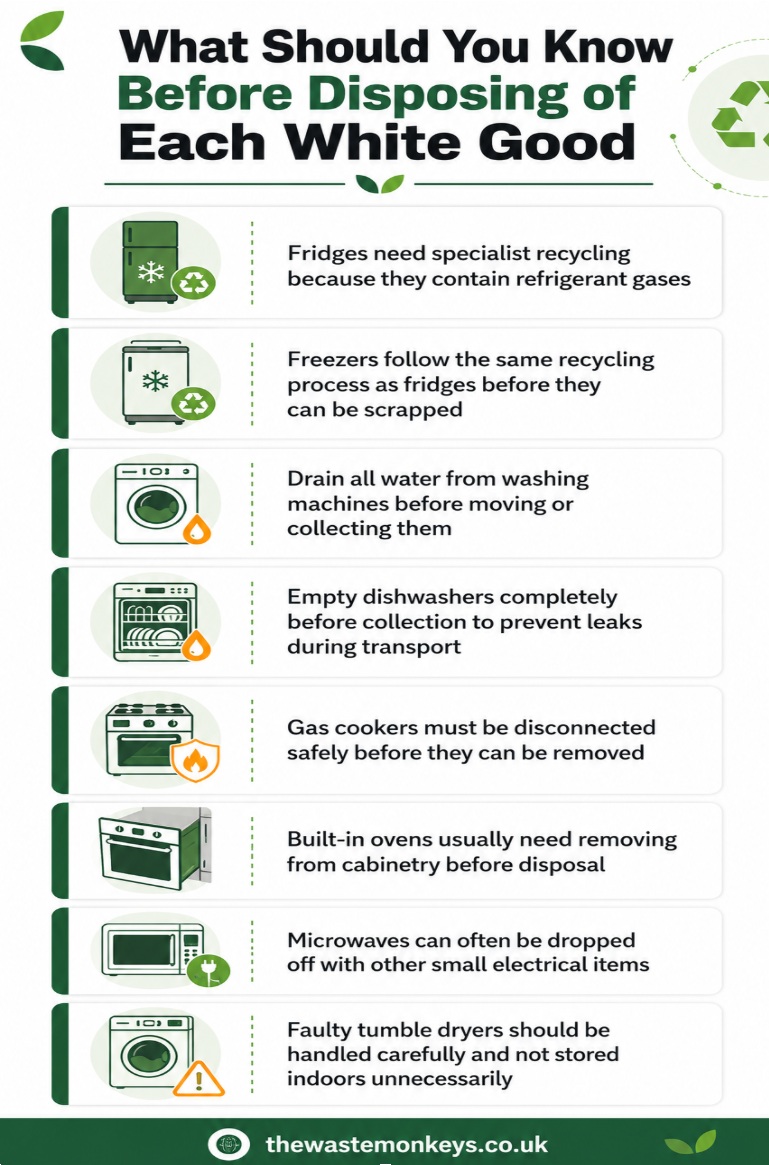
Each appliance has a few points worth knowing before you dispose of it:
Fridge
Fridges require specialist treatment because they contain refrigerant gases, insulation foam with blowing agents and other components that need careful recovery. Before a fridge can be legally scrapped, an F-Gas certified technician must remove these gases.
Crushing a fridge with the refrigerant still inside releases high global warming gases directly into the atmosphere.
The Environment Agency’s waste cooling equipment guidance sets out exactly what is required at treatment facilities.
Freezer
Freezers go through the same disposal process as fridges. WEEE Regulations and F Gas rules both apply, so the refrigerant must be safely recovered before the appliance can be scrapped.
Any compliant household waste recycling centre or licensed waste collector will handle this as part of the process.
Washing Machine
Washing machines are heavy, so retailer take-back on delivery of a replacement is often the most practical route. HWRCs also accept them without issue.
Just drain the drum before you transport it.
Dishwasher
Dishwashers follow the same routes as washing machines. Retailer take-back, HWRC drop-off or a council bulky collection all work well.
Make sure the appliance is empty and the water has drained before it is collected.
Cooker
Before arranging collection, have the gas supply disconnected by a Gas Safe registered engineer. Never try to disconnect a gas cooker yourself. Once it has been made safe and prepared for removal, the appliance can be collected.
Electric cookers, however, can go through the standard WEEE disposal process without any special disconnection work.
Oven
Built-in ovens are often fixed into cabinetry, so you may need a tradesperson to remove it first. Once it is out, HWRC drop-off or a collection service will take it.
Microwave
Microwaves are classed as small WEEE rather than large household appliances. Many larger retailers have in-store drop-off points for small WEEE, alongside the usual HWRC option.
Tumble Dryer
Tumble dryers follow standard large WEEE disposal routes. One practical note, the faulty tumble dryers have been linked to household fires. Handle them with care during transport and do not store a broken unit indoors for longer than necessary.
Can You Take White Goods to the Tip
Household Waste Recycling Centres (HWRCs) are one of the easiest ways to dispose of old white goods. They accept large household appliances free of charge for residents, although the rules vary between councils.
Before you visit, make sure you:
- Check whether your local HWRC requires you to book in advance.
- Confirm your appliance is accepted. Most sites take fridges, freezers, washing machines, dishwashers, ovens, cookers and tumble dryers free of charge.
- Empty and defrost appliances for at least 24 hours, give them a quick clean and make sure they are safe to handle.
- Take proof of local residency if your council requires it.
- Check whether there are any limits on visits or restrictions for vans and trailers.
How Should You Prepare White Goods for Disposal
A few simple checks before collection or drop off can save time and prevent unnecessary problems. They also help protect your property, make the appliance easier to move and ensure it is ready for safe transport.
Complete these steps before your appliance is collected or taken to a recycling centre:
Disconnecting Appliances Safely
Switch off and unplug all electrical appliances before anyone moves them. For gas cookers, have a Gas Safe engineer disconnect the supply. For plumbed-in machines like washing machines or dishwashers, turn off the water supply and disconnect the hoses before collection.
Empty the Appliance
Remove all food, loose shelves, drawers and any other contents before collection or drop off. An empty appliance is lighter, easier to move and less likely to cause spills or damage during transport.
Defrost and Clean It
Fridges and freezers should be defrosted for at least 24 hours before they are moved. Once defrosted, wipe the inside with a damp cloth to remove any moisture, food residue or unpleasant smells.
This makes the appliance safer to handle and easier to recycle.
Removing Personal Items and Data Where Applicable
Smart appliances can store Wi-Fi passwords, user profiles and personal preferences. Before disposal, carry out a factory reset to clear any stored data.
It only takes a minute and it is worth doing.
What Happens to White Goods After Collection
Once your white goods are collected, they go to an Approved Authorised Treatment Facility (AATF) for processing. This is a licensed site where appliances are handled in a controlled, regulated environment.
Here is what happens after your white goods are collected:
The WEEE Recycling Process
At the facility, appliances are sorted by type and then depoluted. This means hazardous substances are removed before any dismantling or shredding takes place.
The materials are then separated ready for onward recovery.
Recovering Valuable Materials
Once hazardous materials have been removed, the remaining parts of the appliance are separated into materials such as steel, aluminium, copper, plastic and glass. These can then be recycled and used to make new products, reducing the need for raw materials.
This process only works if old appliances enter the correct recycling system. Material Focus reports that household WEEE placed on the UK market increased by 25% between 2018 and 2021, while collections rose by just 0.6% over the same period.
That gap shows why disposing of white goods through an approved collection or recycling service is so important.
Safe Disposal of Hazardous Components
Refrigerants from fridges and freezers are handled by certified specialists, not passed into the general recycling stream. Under the F-Gas Service Ban and Product Prohibitions rules enforced by REFCOM, only qualified engineers may recover these gases legally.
Any compliant AATF will have these certifications in place.
How Much Does White Goods Disposal Cost
The cost varies quite a bit depending on which route you choose. Self-transport to a HWRC is free. Asking someone else to collect it will cost money, though the convenience can be well worth it.
Before deciding which option is right for you, compare the typical costs and what each service offers:
| Disposal Method | Typical Cost | Suitable For | Collection Available |
|---|---|---|---|
| HWRC drop-off | Free | All standard white goods | No (self-transport) |
| Council bulky collection | Small fee (varies by council) | Larger appliances, multiple items | Yes |
| Retailer take-back | Free with new appliance purchase | Like-for-like replacement | Yes |
| Licensed waste carrier | Paid service | Convenience, multiple or bulky items | Yes |
The cheapest option is not always the most practical. Your choice will depend on the size of the appliance, whether you can transport it yourself and how quickly you need it removed.
Licensed waste removal companies charge for the convenience of collecting from your property. This option is particularly useful when you have multiple items, difficult access or simply no way to transport large appliances yourself.
Why Proper White Goods Disposal Matters
The way you dispose of an old appliance has a bigger impact than many people realise. Using the correct disposal route helps protect the environment, keeps you on the right side of the law and allows valuable materials to be recycled instead of wasted.
Here are the main reasons proper white goods disposal is so important:
Environmental Benefits
Proper recycling recovers metals, plastics and other materials that would otherwise be lost. It also keeps hazardous substances like refrigerant gases out of the atmosphere, where they would contribute to climate change.
Legal Responsibilities
Householders have a duty of care under Section 34 of the Environmental Protection Act 1990. If you hand your appliance to an unregistered collector and it ends up fly-tipped, you may be held partly responsible.
According to fly-tipping statistics for England, incidents rose 6% to 1.15 million in 2023/24. Councils spent £13.1 million on large-scale clearance that year.
The consequences of getting it wrong go far beyond a messy pavement.
Supporting Recycling and Resource Recovery
The UK is buying more electrical appliances than ever. But collection rates have barely moved. Every appliance sent through a proper disposal route helps close that gap and keeps useful materials in circulation rather than in a ditch.
FAQs
Can I put white goods in my household bin?
No.
White goods are classed as WEEE and cannot go into a standard household bin or general waste collection. They must be disposed of through an approved route such as a HWRC, retailer take-back or licensed carrier.
Can I take a fridge to the tip?
Yes.
Your local HWRC will accept fridges free of charge. The facility handles refrigerant recovery as part of the process.
Do councils collect old white goods?
Many councils offer a kerbside bulky waste collection for a small fee. Availability and pricing vary by local authority, so check your council’s website.
Do retailers collect old appliances when delivering a new one?
Yes.
Retailers are legally required to offer a free like-for-like take-back when delivering a replacement appliance. Always ask at the point of purchase.
Can broken white goods be recycled?
Yes.
HWRCs and licensed collectors accept broken appliances. Condition does not matter for the purposes of WEEE recycling.
Can I donate old white goods?
If the appliance still works, donation to a reuse network or charity is a great option. Some organisations will also collect directly from your home.
Conclusion
Disposing of white goods properly is easier than many people think. Whether you use a recycling centre, council collection, retailer take back or a licensed waste carrier, choosing an approved disposal route protects the environment and keeps you on the right side of the law.
If you need a hassle free solution, contact us for a free white goods collection quote.